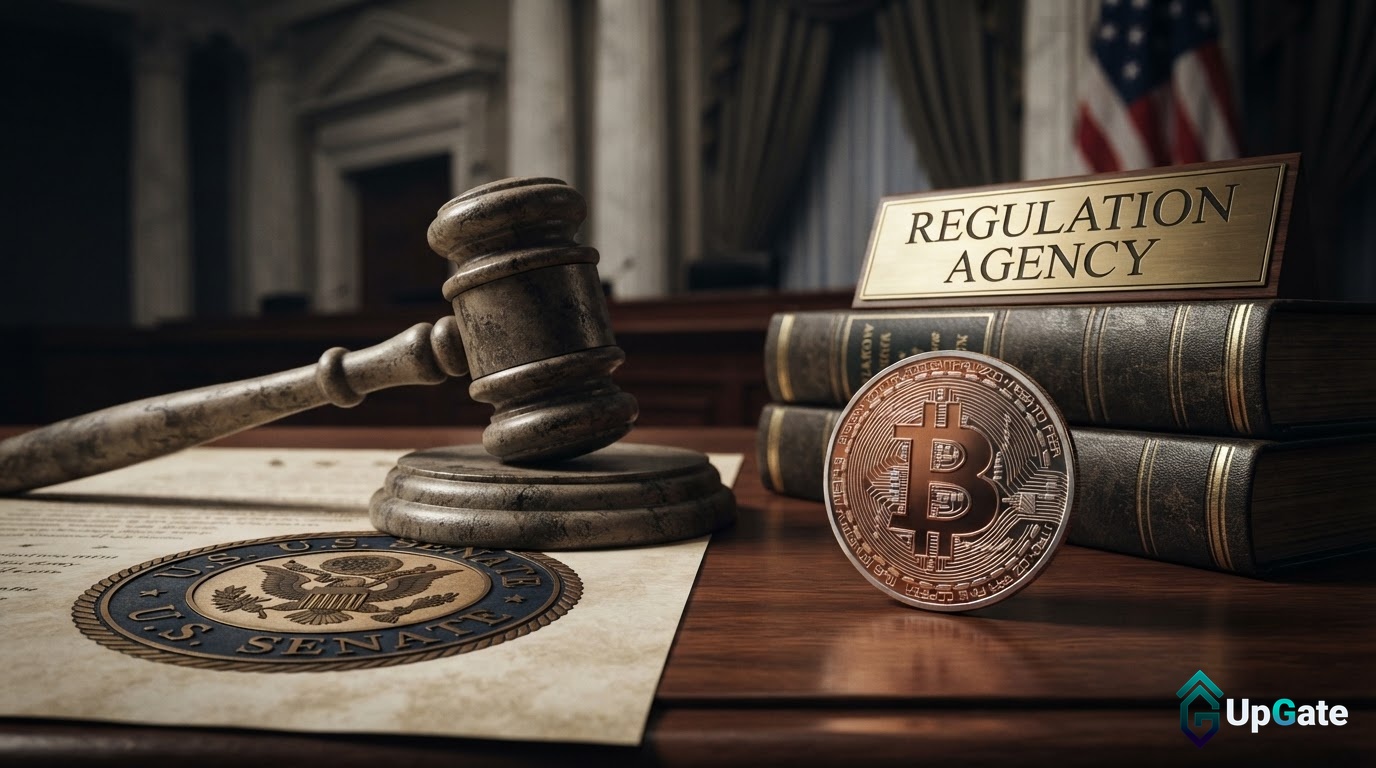
Senate Vote Fails on CLARITY Act, Agencies Push Alternative Regulatory Paths
Following the Senate’s procedural vote defeat of the CLARITY Act, the Securities and Exchange Commission (SEC) and the Commodity Futures Trading Commission (CFTC) have moved swiftly to implement alternative regulatory frameworks. However, SEC Chair Paul Atkins himself has acknowledged that without congressional legislation, these rules remain vulnerable to being overturned by future regulators.
Regulatory Vacuum Filled by Agency Action
The U.S. cryptocurrency market’s regulatory landscape, which many expected to revert to a state of ambiguity after the Senate’s 49-50 vote against the CLARITY Act, has seen the SEC and CFTC take immediate action. On the same day the bill faltered, both agencies began efforts to fill the legislative void with their own rules.
The CLARITY Act’s primary objective was straightforward: to categorize digital assets and clearly delineate which agency, the SEC or CFTC, would oversee them. For the past decade, trading platforms like Coinbase and Kraken have been embroiled in numerous legal battles with the SEC, centered on the fundamental question of whether issuing a token constitutes issuing a security. Enforcement actions and substantial settlements during former SEC Chair Gary Gensler’s tenure largely revolved around this issue.
Had the bill passed, it would have also expanded the CFTC’s oversight role in the spot cryptocurrency market. Tokens like Bitcoin and Ethereum, classified as “commodities,” have long lacked direct regulatory supervision in their spot trading, with the CFTC intervening only in cases of market manipulation. The act also addressed contentious issues such as anti-money laundering provisions and limited legal exemptions for DeFi developers, though these were not the primary reasons for the bill’s ultimate demise.
SEC’s Project Crypto Initiative
Just two days after the bill’s failure, SEC Chair Paul Atkins unveiled a policy initiative for tokenized securities, a core component of his “Project Crypto” framework. Atkins, appointed by President Trump and known for his pro-crypto stance, has prioritized digital asset regulation since taking office. With the legislative path now closed, he believes the SEC must utilize its existing authority to advance what it can.
Last month, the SEC proposed its first significant crypto rule, “Regulation Crypto Assets.” This aims to establish a compliant fundraising channel for crypto projects, allowing them to raise capital without triggering the full suite of securities laws. This rule was advanced by the Republican-majority SEC commission, with the White House intentionally leaving two Democratic seats vacant to enable its passage without Democratic votes.
CFTC’s Independent Actions
The CFTC’s situation is unique. Current Chair Mike Selig, who previously served as Atkins’ crypto lead at the SEC, is the sole remaining member of the five-person commission, granting him the ability to act unilaterally. The CFTC has begun developing rules for prediction markets and recently opened the door to crypto perpetual futures.
Selig stated that his team is creating a classification for “crypto asset markets,” analogous to the CFTC’s existing “Designated Contract Market” (DCM) classification, which would allow compliant exchanges to obtain official certification.
Fragility of Agency Rules
While the SEC and CFTC’s current piecemeal approach offers more clarity than the pre-legislative environment, these are “rules,” not laws. In essence, they are an improvement over the enforcement-driven policies of the Gensler era but are significantly more fragile than actual legislation.
These rules can be challenged in court on grounds of “lack of legislative authority” and can be overturned by subsequent regulators. Although the SEC’s rules were passed unanimously by Republicans, a future Democratic president could nominate a new commission that, while requiring considerable effort, could potentially rewrite them. The CFTC’s Selig is currently operating alone, with only one seat filled on the five-member commission, meaning any new appointees could shift the direction.
Atkins’ Acknowledgment of Weaknesses
Atkins himself is acutely aware of these vulnerabilities. In August, he explicitly stated, “Legislation is still indispensable for establishing forward-looking rules that are durable enough to protect the work we do today from being overturned by rogue regulators in the future.” He has repeatedly emphasized in speeches this year and last that “only Congress can provide forward-looking safeguards for regulation in this space.”
However, he also believes the SEC can be a crucial ally in the legislative process. When he launched Project Crypto in November of last year, he remarked, “The plan I envision is consistent with legislation under consideration by Congress, designed to supplement, not supplant, Congress’s vital work.” The challenge is that Project Crypto can currently only operate independently, awaiting congressional action.
The Shifting Battlefield
The failure of the CLARITY Act does not signify a halt to crypto regulation but rather a shift of the battlefield from Congress back to the regulatory agencies. In the short term, the joint actions of the SEC and CFTC will provide greater clarity. The taxonomy of asset classifications, the framework for tokenized securities, the labeling of crypto spot markets, and rules for prediction markets are all more predictable than the “enforcement as policy” approach of the Gensler era.
However, the durability of these rules is far less than that of legislation. If the power structure in the Senate changes after the midterm elections next year, the bill could potentially be reintroduced. If legislation fails, the industry may face another cycle of rules being completely overturned following a change in political party. Atkins’ repeated emphasis on the “indispensability of legislation” is not mere rhetoric; it highlights the critical weakness of the current policy solutions.